Total Knee Replacement
Mr Dennis Kosuge is a Consultant Orthopaedic Surgeon specialising in knee replacement surgery, based at The Rivers Hospital in Sawbridgeworth (private) and The Princess Alexandra Hospital NHS Trust in Harlow (NHS). He serves patients from across West Essex and East Hertfordshire, including Bishop's Stortford, Epping, Hertford, Chelmsford, Ware, and Hoddesdon.
VELYS™ Robotic-Assisted Knee Replacement — Now Available
For patients seeking the most advanced approach to total knee replacement, Mr Kosuge now offers VELYS™ robotic-assisted knee replacement at The Rivers Hospital, Sawbridgeworth, from July 2026. The VELYS system by DePuy Synthes creates a personalised surgical plan based on your individual anatomy before surgery begins, and provides real-time precision guidance throughout your procedure. Published evidence associates VELYS with improved mobility, shorter hospital stays, and better outcomes than conventional knee replacement. Mr Kosuge will advise at consultation whether robotic-assisted surgery is the right approach for your individual situation.
Find out more about VELYS™ robotic-assisted knee replacement
Frequently Asked Questions about Total Knee Replacements
Do I Need a Total Knee Replacement?
What is Total Knee Replacement Surgery?
How do I know if I need a total or partial knee replacement?
Will I need a general anaesthetic for my knee replacement?
What happens on the day of knee replacement surgery?
Is knee replacement surgery painful?
How long is the recovery after knee replacement?
Can I return to sport after knee replacement?
How long does a knee replacement last?
Is robotic-assisted knee replacement available with Mr Kosuge?

Mr Kosuge’s Patient Information Booklet on Knee Osteoarthritis. Please click on image to access the leaflet.
Do I need a Total Knee Replacement?
Knee replacement is most commonly performed for osteoarthritis of the knee, though it may also be appropriate for rheumatoid arthritis, post-traumatic arthritis, and other conditions causing severe joint damage. Mr Kosuge may recommend knee replacement if you have:
Persistent knee pain that significantly affects your daily activities and has not responded to non-surgical treatments
Pain that limits your ability to walk, climb stairs, or rise from a chair
Pain at rest or at night that disturbs your sleep
Significant deformity of the knee, such as bowing inward or outward
X-ray evidence of advanced joint degeneration
Mr Kosuge takes a thorough and unhurried approach to assessment, ensuring that non-surgical options such as physiotherapy, weight management, and injections are considered before recommending surgery. The decision to proceed will always made jointly with you.
What is Total Knee Replacement Surgery?
Knee replacement surgery — also known as total knee arthroplasty — is a highly effective procedure that involves removing the damaged surfaces of the knee joint and replacing them with carefully designed metal and plastic components. It is one of the most frequently performed operations in orthopaedic surgery and consistently delivers significant improvements in pain, function, and quality of life.
How do I know if I need a total or partial knee replacement?
Mr Kosuge will assess this at your consultation using weight-bearing X-rays, examination and your symptoms. A partial (unicompartmental) knee replacement is suitable when arthritis is confined to one compartment and the ligaments are intact. If arthritis affects multiple compartments or the ligaments are damaged, a total replacement is more appropriate. Mr Kosuge will be happy to assess and have a discussion regarding which is most appropriate for you at your consultation.
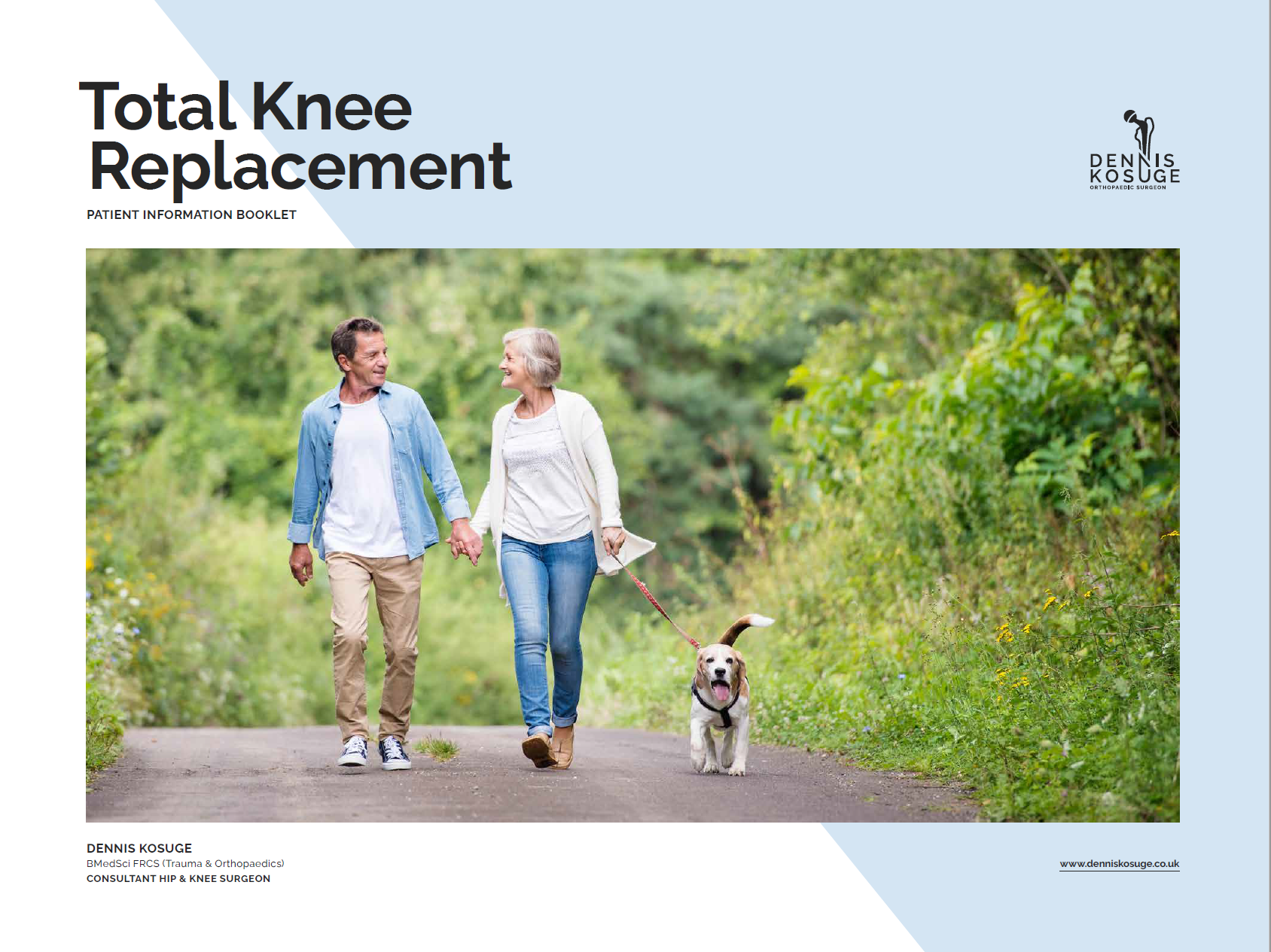
Mr Kosuge’s Patient Information Booklet on Total Knee Replacement surgery. Please click on image to access the booklet.
Will I need a general anaesthetic for my knee replacement?
Most knee replacements performed by Mr Kosuge are carried out under spinal anaesthesia, meaning you are awake but numb from the waist down and feel no pain. Understandably, many patients do not want to be awake so the option of sedation is available in addition to the spinal anaesthetic. Formal general anaesthesia is occasionally used in cases where spinal anaesthesia may be inappropriate or not possible to administer.. The anaesthetist will discuss the best option for you at your pre-operative assessment.
What happens on the day of knee replacement surgery?
You will arrive at The Rivers Hospital, be assessed by Mr Kosuge, your anaesthetist and nursing team, and then taken to theatre. The operation typically takes one to two hours. Most patients begin walking with physiotherapy support on the day of surgery.
Is knee replacement surgery painful?
Post-operative pain is managed with a carefully planned analgesic regime and is often helped by modern anaesthetic and surgical techniques. Most patients find their knee pain is significantly better than before surgery after the initial few weeks from the operation.
How long is the recovery after knee replacement?
Most patients return to daily activities within 8 to 12 weeks and feel substantially recovered by 4 to 6 months. It is important to begin knee stretches and exercises straight after your operation. Swelling and stiffness can persist for up to one year.
Mr Kosuge provides detailed written information to support your recovery. Mr Kosuge's patient outcome data, collected independently, is available to view on this website and reflects his commitment to high-quality care.
Can I return to sport after knee replacement?
Many low-impact activities — including cycling, swimming, walking and golf — are achievable after knee replacement. Activities requiring deep bending such as squatting or kneeling can remain challenging. Most patients find they are significantly more active after surgery than before. Mr Kosuge will discuss your individual activity goals at your consultation.
How long does a knee replacement last?
Modern total knee replacements are designed to last 15 to 20 years or more in the majority of patients. More active patients (e.g. under 50) may wear out their implant faster and maintaining a healthy body weight can reduce the strain on your new joint replacement.
Is robotic-assisted knee replacement available with Mr Kosuge?
Yes. From July 2026, Mr Kosuge offers VELYS robotic-assisted total knee replacement at The Rivers Hospital, Sawbridgeworth. The VELYS system by DePuy Synthes creates a personalised surgical plan based on each patient's individual anatomy during surgery and provides real-time precision guidance throughout the procedure. Mr Kosuge will advise at consultation whether robotic-assisted surgery is the most appropriate option for your individual situation.
More Frequently Asked Questions:
-
Being overweight does not automatically exclude you from knee replacement, but it does increase the risk of certain complications. Mr Kosuge will discuss your weight and its impact on surgical risk at your consultation and advise whether weight loss before surgery is recommended in your case.
-
Most patients can return to driving 6 to 8 weeks after knee replacement, once Mr Kosuge has confirmed that your reaction times and leg strength are safe. You must not drive until you have been specifically cleared at your follow-up appointment.
-
The cost varies depending on the complexity of your case. Mr Kosuge is recognised by all major health insurers including BUPA, AXA Health, Aviva and Vitality. Self-pay fee information is available on the Fees page or by calling 01279 602675.
Book a Consultation
If you are suffering from knee pain and would like an expert assessment, Mr Kosuge welcomes private referrals at The Rivers Hospital, Sawbridgeworth. He is recognised by all major health insurers including BUPA, AXA, Aviva, Vitality, and WPA. Self-pay patients are also welcome.
To book an appointment, please call 01279 602675 or use the online booking link below.
NHS patients may be referred by their GP to The Princess Alexandra Hospital, Harlow.