
Hip Labral Tear
Mr Dennis Kosuge is a Consultant Orthopaedic Surgeon with a specialist interest in hip conditions, including labral tears of the hip. This page explains what a hip labral tear is, why it happens, how it is diagnosed and the treatment options, both non-surgical and surgical. Mr Kosuge sees and treats patients with hip labral tears at The Rivers Hospital in Sawbridgeworth (private) and at The Princess Alexandra Hospital, Harlow (NHS).
Frequently Asked Questions about Labral Tears
What are the symptoms of a hip labral tear?
What causes a hip labral tear?
How is a hip labral tear diagnosed?

Mr Kosuge’s Patient Information Leaflet on Hip Labral Tear. Please click on image to access the leaflet.
What is a hip labral tear?
The labrum is a rim of strong cartilage that surrounds the socket of the hip joint. It deepens the socket, helps to hold the ball of the hip securely in place and acts as a seal that keeps the joint stable and well lubricated. A labral tear is damage to this rim of cartilage. It is a recognised cause of hip and groin pain, particularly in younger and active adults, although it can occur at any age. A tear may follow a specific injury, but more often it develops gradually, frequently in association with a subtle difference in the shape of the hip known as impingement.
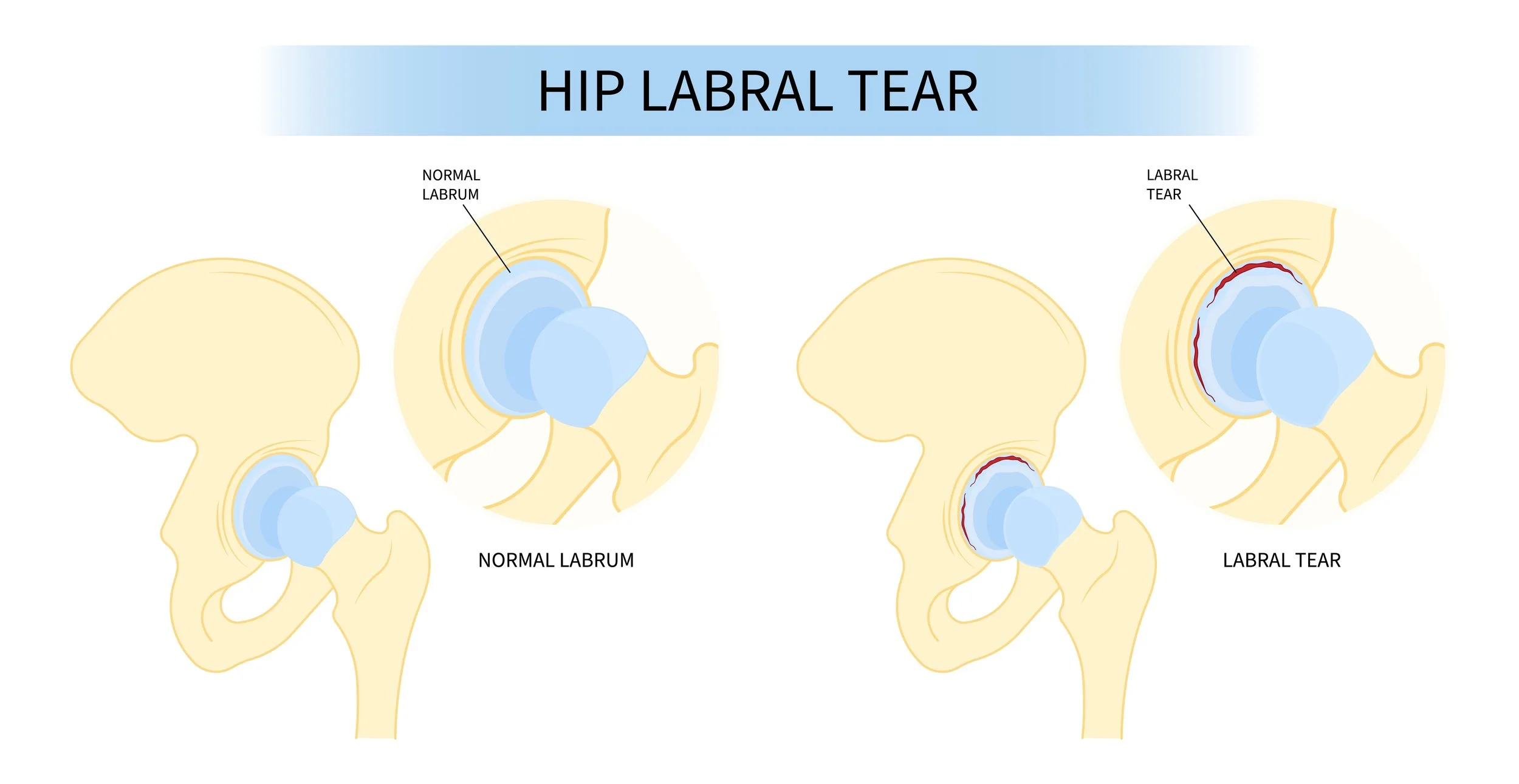
What are the symptoms of a hip labral tear?
Symptoms vary but commonly include pain felt in the groin or at the front of the hip, which may be worse with activity, prolonged sitting, or movements that bring the knee towards the chest. Some patients notice clicking, catching or a locking sensation in the hip, and a feeling that the hip is stiff or does not move freely. The symptoms are often intermittent at first and are aggravated by sport, twisting movements or getting in and out of a car. Many people describe cupping a hand around the side of the hip to point to the pain, a sign sometimes called the C-sign.
What causes a hip labral tear?
There are several causes. The most common is femoroacetabular impingement, often shortened to FAI, in which slightly extra bone on the ball or socket of the hip pinches the labrum during movement and damages it over time. Labral tears can also result from a hip that is shallow or dysplastic, from a specific injury or twisting force, and from the general wear that comes with age (osteoarthritis). Because the underlying cause influences the best treatment, Mr Kosuge assesses not only the tear itself but the shape and mechanics of the whole hip.
How is a hip labral tear diagnosed?
Diagnosis begins with a careful history and examination of the hip, including specific movements that reproduce the pain. Plain X-rays are used to look at the shape of the hip and to check for impingement or early arthritis. An MRI scan, sometimes performed with a contrast injection into the joint known as an MR arthrogram, is the most useful test for showing the labrum itself. In some cases an injection of local anaesthetic into the hip is used to help confirm that the joint is the true source of the pain.
Mr Kosuge’s Patient Information Leaflet on Developmental Dysplasia of the Hip. Please click on image to access the leaflet.
Can a hip labral tear be treated without surgery?
Yes, in many cases. Mr Kosuge's approach begins with non-surgical treatment where appropriate. This can include activity modification to avoid the movements that provoke symptoms, physiotherapy to improve the strength and control of the muscles around the hip and pelvis, and anti-inflammatory medication.
An injection into the hip can also help to settle symptoms and, at the same time, provide useful diagnostic information. For a proportion of patients these measures control the symptoms well and an operation is not needed.

Mr Kosuge’s Patient Information Booklet on Hip Joint Injection. Please click on image to access the booklet.
When is surgery recommended?
Surgery is considered when a labral tear is causing significant symptoms that have not settled with a reasonable period of non-surgical treatment, particularly in younger, active patients and where there is an underlying impingement that can be addressed. The operation is usually performed as hip arthroscopy, a keyhole procedure. Depending on the tear, the labrum is either repaired, preserving as much of the tissue as possible, or carefully trimmed, and any impingement bone is reshaped at the same time. Mr Kosuge will explain honestly whether surgery is likely to help in your particular case.
Can a hip labral tear lead to arthritis?
A labral tear, and particularly the impingement that often causes it, can contribute over time to wear of the joint surface and the development of hip osteoarthritis in some patients. This is one reason for assessing and, where appropriate, treating the underlying cause rather than the tear alone. Where arthritis is already established, the treatment focus changes and hip arthroscopy is generally less helpful. Mr Kosuge will assess the state of the whole joint before recommending treatment.
More Frequently Asked Questions:
-
The labrum has a limited blood supply, so a tear does not usually heal completely on its own. However, this does not mean that every labral tear needs surgery. Many people manage well with their symptoms controlled by non-surgical treatment, even though the tear itself remains. The decision to operate depends on how much the tear is affecting you, your age and activity level, and whether there is a correctable underlying cause, rather than on the presence of the tear alone.
-
Femoroacetabular impingement and labral tears are closely related. In impingement, extra bone on the ball or the rim of the socket causes the two to make abnormal contact during movement, and over time this repeatedly pinches and damages the labrum. This is why treating a labral tear on its own, without addressing the impingement that caused it, may not give a lasting result. With hip arthroscopy, the impingement is usually reshaped at the same time as the labrum is treated.
-
Staying active is encouraged, but the type of activity matters. Low-impact exercise such as swimming and cycling is usually well tolerated and helps to maintain strength around the hip. Movements that repeatedly provoke the pain, such as deep squatting, twisting or high-impact activities, are best avoided until the hip has been assessed and a plan agreed. Mr Kosuge, working with a physiotherapist, can advise on which activities are appropriate for you.
Book a Consultation
If you have groin or hip pain that may be due to a labral tear, an accurate assessment is the first step. Mr Kosuge will examine your hip, review any imaging and explain the options honestly, including the option of not operating.
To book an appointment at Rivers Hospital, High Wych Road, Sawbridgeworth CM21 0HH, please call 01279 602675 or use the online booking link below.
NHS referrals to The Princess Alexandra Hospital, Harlow are also accepted via your GP.